If your online store gets traffic but no sales, the problem is rarely your product. It is your store. Poor navigation, slow load times, and a checkout that confuses buyers push people away before they click “buy.” That is why business owners across Pakistan and beyond now turn to professional Shopify store development to fix leaks in their sales funnel and turn visitors into paying customers. A store built on guesswork loses money every single day. A store built on strategy converts.
Many founders assume more traffic solves everything. It does not. You can run paid campaigns all day, and industry benchmarks compiled by WordStream on average conversion rates show most traffic still fails to convert without a store built to close the sale. Fixing the foundation first, then scaling traffic, is the order that actually works.
Why Your Store Is Not Converting
Before jumping into solutions, it helps to understand where most Shopify stores fail. Here are the most common issues we see:
- Slow page speed caused by heavy themes and unoptimized images
- Confusing navigation that hides products behind too many clicks
- Weak product pages with no clear value proposition
- Checkout friction such as forced account creation or hidden shipping costs
- No mobile optimization despite most shoppers browsing on phones
- Missing trust signals like reviews, secure badges, or clear return policies
Each of these issues chips away at your conversion rate. Usability research from Group on ecommerce user experience consistently links weak navigation and checkout friction to lower sales across hundreds of tested online stores.
What Custom Shopify Store Development Actually Means
Custom Shopify store development is not just picking a theme and adding your logo. It means building a store around your specific customer journey, your products, and your growth goals. At Devstren, our Shopify development service focuses on structure first, design second, and add-ons last.
A properly developed Shopify store includes:
- A clean information architecture so customers find products fast
- Custom theme sections tailored to how your products are sold
- Speed-optimized images, code, and apps
- Conversion-focused product and collection pages
- A checkout flow with minimal friction
- Analytics setup so you can track what is working
This is the difference between a store that looks nice and a store that sells.
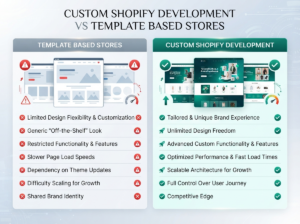
Custom Development vs Template-Based Stores
Business owners often ask whether a ready-made theme is enough. Here is an honest comparison.
| Factor | Template-Based Store | Custom Shopify Development |
| Design uniqueness | Same look as thousands of other stores | Built around your brand identity |
| Page speed | Often bloated with unused code | Streamlined and optimized |
| Scalability | Limited once you outgrow the theme | Built to grow with your catalog |
| Conversion rate | Generic layout, generic results | Structured for your specific buyer journey |
| App compatibility | Frequent conflicts and bugs | Tested integrations that work together |
| Long-term cost | Cheaper upfront, costly fixes later | Higher upfront, lower maintenance cost |
A template can work for a small test store. But once you are serious about sales and leads, custom development pays itself through fewer abandoned carts and stronger repeat purchases.
The Role of SEO in Shopify Store Development
A beautiful store with zero visibility does not generate sales. This is where SEO and development must work together, not separately. Our SEO services team works alongside our developers, so your store is technically built for search engines from day one, not patched afterward.
Key SEO elements built into every Devstren Shopify project:
- Clean URL structures without unnecessary parameters
- Optimized product titles and meta descriptions
- Structured data markup so Google understands your products
- Fast-loading pages that meet current performance standards
- Internal linking between collections, products, and blog content
Search visibility and store structure are connected. A well-built store makes SEO easier. A poorly built store fights against every SEO effort you make, a point echoed in Ahrefs’ guide to ecommerce SEO.
Why Cart Abandonment Is a Development Problem
Many merchants blame marketing when carts get abandoned. Checkout design is often the real cause. Data compiled by Contentsquare on shopping cart abandonment consistently shows that unexpected costs, complicated checkout processes, and mandatory account creation are among the top reasons shoppers leave without buying.
Our approach to custom Shopify development fixes this by:
- Showing shipping costs early in the shopping experience
- Offering guest checkout as a default option
- Reducing form fields to only what is necessary
- Adding trust badges near the payment button
Small changes here often produce a bigger sales lift than any single marketing campaign.
Mobile First Is No Longer Optional
Most Shopify traffic now comes from mobile devices. If your store was designed for desktop first, mobile shoppers are likely struggling with tiny buttons, slow menus, and awkward image sizing. Consumer research from Think with Google shows mobile shopping continues to grow year over year, which makes mobile-first development a requirement, not a bonus feature.
Devstren builds every store’s mobile-first, then scales up to desktop, so the experience never feels like an afterthought.
How Devstren Approaches Shopify Development
Our process is built around results, not just delivery. Here is what working with us looks like:
- Discovery call to understand your products, audience, and goals
- Store architecture planning before any design work begins
- Custom theme development with speed and SEO built in
- Conversion-focused product and checkout page design
- Testing across devices and browsers
- Launch support and post-launch optimization
We also handle ongoing support and optimization once your store is live, including deeper guidance like our Shopify custom theme, and connect your store with tools like Google Analytics so you can track visitor behavior and sales performance after launch.
If you already have a Shopify store that is underperforming, our team can audit your current setup and show you exactly where sales are being lost.
Signs You Need Professional Shopify Development
You likely need expert help if:
- Your bounce rate is high despite decent traffic
- Mobile visitors leave faster than desktop visitors
- Your product pages look identical to a dozen competitors
- You are losing sales at checkout, not at the product page
- Your store takes more than three seconds to load
If any of this sounds familiar, the issue is fixable. It starts with a proper development audit, not another marketing experience.
Frequently Asked Questions
Q: What is Shopify store development?
A: Shopify store development is the process of building or customizing a Shopify store’s structure, design, and functionality, so it matches your business goals and gives customers a smooth, fast shopping experience.
Q: How does custom development differ from using a Shopify theme?
A: A custom build is designed around your specific products and buyer journey, while a stock theme applies to a generic layout used by many other stores, often leading to slower speed and lower conversions.
Q: Why should I invest in professional Shopify development instead of DIY?
A: Professional development addresses speed, mobile usability, and checkout friction correctly the first time, reducing costly fixes later and helping your store perform better in search and sales.
Q: How long does a Shopify store development project usually take?
A: Timelines vary based on catalog size and features needed, but most projects move through discovery, design, development, and testing phases before a final store launch.
Q: What should I expect during the development process?
A: Expect discovery calls, architecture planning, design reviews, and testing stages before launching, with regular updates so you understand exactly what is being built and why.
Q: Do you also handle SEO during Shopify development?
A: Yes, technical SEO elements like clean URLs, structured data, and page speed are built into the store during development instead of being added as a separate step afterward.
Q: Can I migrate my existing store to a new custom Shopify design?
A: Yes, existing product data, customer information, and order history can typically be migrated into a newly developed store without losing your existing catalog or history.
Q: How do I choose the right Shopify development partner?
A: Look for a team that asks about your business goals first, shows past e-commerce work, explains their process clearly, and treats development and SEO as connected, not separate services.
Final Thoughts
Sales and leads do not disappear because customers stopped wanting your product. They disappeared because the store between the customer and the purchase button was not built to convert. Shopify store development is not a one-time task; it is the foundation your entire online business stands on. Get the foundation right, and every marketing dollar you spend afterward works harder for you.
If you are ready to fix the leaks in your store and turn visitors into buyers, Devstren can help you build a Shopify store designed around real conversions, not just a nice-looking template.