If your store gets visitors but not sales, the problem is rarely luck. Most of the time it comes down to who built and maintains your store. Picking the right shopify web development agency is the single decision that shapes your load speed, your checkout experience, your search visibility, and ultimately how many visitors turn into paying customers. This guide breaks down exactly what to look for, what to avoid, and how to compare agencies with confidence instead of guesswork.
Traffic without conversion is one of the most frustrating problems an online store owner can face. You run ads, you post on social media, people click through, and then they leave without buying anything. According to Baymard Institute research, the average cart abandonment rate sits above 70 percent, and a large share of that loss comes from slow pages, confusing navigation, and checkout friction that a skilled development team is trained to fix.
A well-built theme also needs to follow platform rules. Reviewing Shopify’s own theme documentation is a useful way to see what a properly structured store should include before you compare quotes.
Why Your Store Might Be Losing Sales
Before you hire anyone, it helps to understand what is actually costing you leads and revenue. A few common culprits show up again and again on Shopify stores.
- Slow-loading product and collection pages
- A theme that was never customized for your actual customer journey
- Broken or confusing mobile checkout
- No clear call to action above the fold
- Weak internal linking and product page structure that search engines cannot read easily
- Apps stacked on top of apps, slowing everything down
None of these problems are permanent. They are fixable, but only if the team fixing them understands Shopify at a technical level, not just how to drag and drop a theme. You can see how these fixes look in practice in our recent project work.
What a Real Shopify Web Development Agency Should Deliver
A capable agency does more than make your store look nice. Real value shows up in performance, structure, and long-term stability. Here is what should be part of the conversation from day one.
- Custom theme development or deep customization, not a stock template
- Page speed optimization aligned with Google Core Web Vitals
- Clean, crawlable site architecture built for organic search
- Mobile-first design since most Shopify traffic now arrives from phones
- App audits so you are not paying for tools that slow your store down
- Ongoing support after launch, not a one-time handoff
If an agency cannot speak clearly about any of these points, that is worth noting before you sign anything.
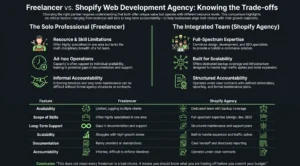
Freelancer vs Shopify Web Development Agency
Many store owners start with a freelancer because it feels cheaper. Sometimes that works. Often it creates problems later. Here is a side-by-side to look at the difference.
| Factor | Freelancer | Shopify Web Development Agency |
| Availability | Limited, often one person juggling many clients | Dedicated team with backup coverage |
| Scope of skills | Usually strong in one area only | Combines design, development, and SEO |
| Long term support | Frequently disappears after launch | Structured maintenance and update plans |
| Scalability | Struggles with larger or growing stores | Built to handle traffic spikes and expansion |
| Documentation | Rarely provided | Clear handoff and reporting |
| Accountability | Hard to enforce timelines | Contracts and defined deliverables |
This does not mean every freelancer is a bad choice. It means you should know what you are trading off before you commit your budget.
How To Choose a Shopify Web Development Agency
Once you understand the difference between good and average work, the selection process becomes much easier. Use these steps to compare your shortlist.
- Review real client stores, not just polished screenshots on a portfolio page
- Ask how they measure success beyond “the site looks good”
- Confirm whether SEO and page speed are part of the build or a separate add-on
- Check if they list themselves in the official Shopify Partner Directory
- Ask directly what happens after launch if something breaks
- Compare pricing structures, since flat fees and hourly billing behave very differently over time
Learn more about how Shopify vets partners through the Shopify Help Center, which explains how listings work and what to check before reaching out. If you want a starting point for that comparison, our Shopify development service page outlines exactly what a full engagement includes.
Signs You Are Talking to the Right Team
- They ask about your business goals before talking about design
- They can explain technical decisions in plain language
- They talk about conversion rate, not just aesthetics
- They mention testing and staging environments before pushing changes live
- They have experience with stores similar in size to yours
If you are unsure where your own store stands on any of these points, reaching out to Devstren gets you a review of exactly these signals before any work begins.

Red Flags to Watch For
- Vague answers about timelines or pricing
- No mention of SEO, speed, or mobile experience
- Pressure to sign quickly without a discovery call
- Portfolio links that no longer work or load slowly
- Promises of guaranteed rankings or overnight results
If you want to see how Google’s own SEO starter guide defines a healthy, crawlable site, it lines up closely with what a legitimate development partner should already be doing by default.
Why Development and SEO Cannot Be Separated
A fast, well-built store means little if search engines cannot find it, and strong keyword targeting means little if the site behind it is slow or confusing. This is why the strongest development partnerships combine both disciplines under one roof. Devstren approaches every Shopify to build this way, starting with a technical audit before touching design, so speed, structure, and search visibility grow together instead of competing for attention.
If you already have a store and are unsure where the leaks are, our SEO services are a good starting point before a full rebuild. For a broader look at how Google evaluates a site’s overall structure, Google Search Central’s documentation hub covers the same fundamentals our audits check for.
What Working With Devstren Looks Like
Every engagement starts with a review of your current store, your traffic sources, and where visitors are dropping off. From there, the plan usually includes:
- A technical and speed audit of the existing theme and apps
- A custom build or targeted fixes depending on budget and timeline
- On-page SEO structure built into the theme, not bolted on afterward
- Mobile testing across real devices before launch
- A support plan so the store keeps performing after the project ends
The goal is simple. Your store should load fast, look credible, and guide visitors toward checkout without friction.
Frequently Asked Questions
Q: What does a shopify web development agency actually do?
A: It builds, customizes, and maintains Shopify stores, handling theme development, app integration, page speed, and site structure, so the store performs well for both shoppers and search engines.
Q: How does a specialized agency differ from a general web design company?
A: A dedicated agency focuses specifically on Shopify’s platform rules, apps, and checkout systems, while a general web design company may work across many platforms without the same depth of Shopify specific technical knowledge.
Q: Why should I hire an agency instead of building my store myself?
A: Building a store yourself works for simple setups, but an agency brings experience with speed optimization, mobile usability, and SEO structure that most store owners do not have time to learn on their own.
Q: How long does a typical Shopify development project take?
A: Timelines vary based on scope, but most custom builds take a few weeks to a few months, while smaller fixes or optimizations can often be completed in a shorter, more focused sprint.
Q: What should I expect during the discovery phase?
A: Expect questions about your goals, current traffic, budget, and pain points. A thorough discovery phase helps the agency recommend the right scope instead of guessing a solution.
Q: Do you work with existing Shopify stores or only new builds?
A: Most agencies, including Devstren, work with both. Existing stores can often be improved through targeted fixes rather than a full rebuild, depending on what the audit reveals.
Q: Can I request SEO to work alongside development?
A: Yes. Site structure, page speed, and on-page SEO are closely connected, so requesting them together usually leads to a more cohesive result than treating them as separate projects.
Q: How do I choose between multiple Shopify agencies I am considering?
A: Compare their portfolios, ask for references, confirm their address speed and SEO, and check their listing in the Shopify Partner Directory before making a final decision.
Final Thoughts
Choosing a shopify web development agency is not about finding the cheapest quote or the flashiest portfolio. It is about finding a team that understands how design, speed, and search visibility work together to turn visitors into customers. Ask direct questions, compare real results, and prioritize agencies that treat SEO and development as one connected process rather than two separate line items. If your current store is not converting the way it should, a proper technical review is usually the fastest way to find out why.
Ready to see where your store is losing sales? Get in touch with Devstren for a straightforward review of your Shopify store.